
Sharing the Model: Outreach & Global Impact
One of the central goals of the Wood River Wolf Project is to ensure that communities far beyond the Wood River Valley have access to practical, science-based tools for living with wolves.
What began as a local field experiment has grown into an internationally recognized model for predator–livestock coexistence. Through conferences, summits, workshops, artistic collaborations, and global partnerships, the Project shares its experience so that other regions can replicate and adapt this work.
Below are highlights of outreach efforts featuring the Wood River Wolf Project.
January - February 2026: Tales from the Wild, Bowen Crossing Library
Tales from the Wild. A two-part storytelling series featuring J Dallas Gudgell, Fort Peck Assiniboine and Sioux Tribal Member and Director of the Buffalo Field Campaign, Ed Cannady, Sawtooth Wilderness Backcountry Expert, and Suzanne Asha Stone, co-founder of the Wood River Wolf Project, sharing stories on wolves, buffalo, and grizzly bears.
December 2025: Community Library Program, Ketchum
In December 2025, the International Wildlife Coexistence Network hosted a public program at the Community Library, bringing together residents for an in-depth discussion on wolf ecology, nonlethal management, and the future of coexistence in the Wood River Valley. Speakers included: James Holt, IWCN Board Member and Nez Perce tribe wildlife manager, J Dallas Gudgell, Coexistence Council Member and Fort Peck Assiniboine and Sioux Tribal Member, and Suzanne Asha Stone, co-founder of the Wood River Wolf Project. https://vimeo.com/1130979920
The event provided:
Updates on local wolf pack activity
A review of nonlethal tools and monitoring methods
Discussion of current policy challenges
Audience Q&A and open dialogue
Public forums like this strengthen transparency, build trust, and ensure that coexistence remains rooted in community understanding and engagement.
Local education is as vital as international outreach. By keeping the community informed and involved, the Project sustains the social foundation necessary for long-term wolf protection.
October 2025: IUCN Summit – Dubai
The Wood River Wolf Project was represented at the International Union for Conservation of Nature (IUCN) summit in Dubai, one of the world’s most influential global gatherings on biodiversity and conservation policy.
Participation in the IUCN forum placed the Project’s coexistence model alongside international efforts addressing human–wildlife conflict across continents. The lessons learned in the mountains of central Idaho — adaptive management, nonlethal deterrence, stakeholder collaboration, and data-driven decision-making — were shared with conservation leaders working with large carnivores from Africa to Asia.
The Project’s presence at IUCN reflects its evolution from a regional initiative to a globally relevant framework for coexistence.
September 2025: Idaho to Colorado: Sharing Success in Carbondale
As Colorado prepares for and implements wolf restoration, the Wood River Wolf Project has provided guidance and a real-world perspective to communities navigating the return of wolves.
In Carbondale, Colorado, Idaho representatives — including members of the Wood River Wolf Project team — shared firsthand accounts of successful wolf coexistence in Blaine County. The event provided Colorado ranchers, wildlife managers, and community members with practical insight into how proactive, nonlethal deterrence can reduce conflict while maintaining viable wolf populations.
By sharing nearly two decades of field-tested experience, the Project contributed to informed dialogue in a state entering a new chapter of wolf recovery.
The message was clear: coexistence is possible when communities act early, collaboratively, and strategically.January 2025: Wolf GirlPerformance – Hailey, Idaho
Outreach is not limited to scientific and policy audiences.
In Hailey, the Project collaborated with community partners to support the Wolf Girl performance — a creative exploration of humanity’s relationship with wolves and the wild.
Events like this invite reflection, dialogue, and cultural engagement. They create space for art, storytelling, and science to intersect — reminding us that coexistence is not only about management strategies, but also about values, imagination, and community identity.
By engaging audiences both emotionally and intellectually, the Project strengthens public understanding and builds long-term tolerance for wolves.
October 2024: International Wildlife Coexistence Network, Turin, Italy
The Wood River Wolf Project is a primary program of the International Wildlife Coexistence Network (IWCN), a nonprofit organization dedicated to advancing science-based, nonlethal solutions to human–wildlife conflict worldwide.
Through IWCN, the Project contributes to:
International training workshops
Policy discussions on predator management
Academic collaboration and research exchange
Development of replicable coexistence models
Wildlife biologists and practitioners from Europe, Israel, Africa, Australia, and across North America have studied and adapted elements of the Wood River model to address conflicts involving wolves, lions, snow leopards, and other large carnivores.
By sharing data, methods, and lessons learned, the Project extends its impact far beyond Idaho.
Hosting Delegations & Field Exchanges
In addition to traveling, the Wood River Wolf Project regularly hosts:
Wildlife professionals
Agency staff
Ranchers from other regions
Graduate students and researchers
Conservation leaders from around the world
Field visits allow participants to see nonlethal strategies implemented in real time across a large, rugged grazing landscape. These exchanges foster collaboration and accelerate the adoption of effective coexistence practices.
Why Outreach Matters
Human–wildlife conflict is one of the leading challenges in conservation globally.
By sharing nearly two decades of field-tested experience, the Wood River Wolf Project contributes to a growing international movement demonstrating that lethal control is not the only option.
Coexistence requires science.
It requires collaboration.
And it requires communities willing to try something different.
From the Sawtooth National Forest to global conservation summits, the Wood River Wolf Project continues to lead by example.
Wolves, Sheep and 12 years of Coexistence
Presentation at the Community Library in Ketchum, Idaho on Wednesday, October 30 from 6:00 - 7:30 pm. Join us for an evening learning about a local project that has gained international interest through its pioneering nonlethal measures protecting domestic livestock and wild predators like wolves. Project leaders Larry Schoen, former Blaine County Commissioner, and Suzanne Asha Stone, project co-founder, will explain why sheep losses to wolves in the local area are among the lowest in the state and how this benefits both local agriculture and our resident wolf packs.
The Wood River Wolf Project has just quietly completed its 12 year in the valley while serving as a model for livestock and wildlife conflict management across the west and around the world. Find out how you can become involved in this effort and why it matters to our ranching, ecological and tourism efforts. Free to the public. Details - contact Suzanne@woodriverwolfproject.org
Coexistence Workshop in Big Timber, Montana
October 2019
Compassionate Conservation Workshop in Pray, Montana
October 2019
Human Wildlife Dimensions - Colorado State Pathways 2019 Conference
September 2019
Coexistence Training Workshop in Medford, Oregon
September 2019
Coexistence and Nonlethal Tools Workshop in Elgin, Oregon
June 2017
Reid Hensen (Lava Lake/WRWP intern for the summer of 2017) and Claudio (camptender of Lava Lake Land & Livestock for 15 years), represented the Wood River Wolf Project at a Coexistence and Nonlethal Tools Workshop in Elgin in the Blue Mountains of Oregon. They brought along a WRWP Band Kit and showed operators and herders how to use the nonlethal tools. Thanks to Shane Stevenson and Cameron Krebs of Krebs Livestock, and Suzanne Stone for organizing this event!
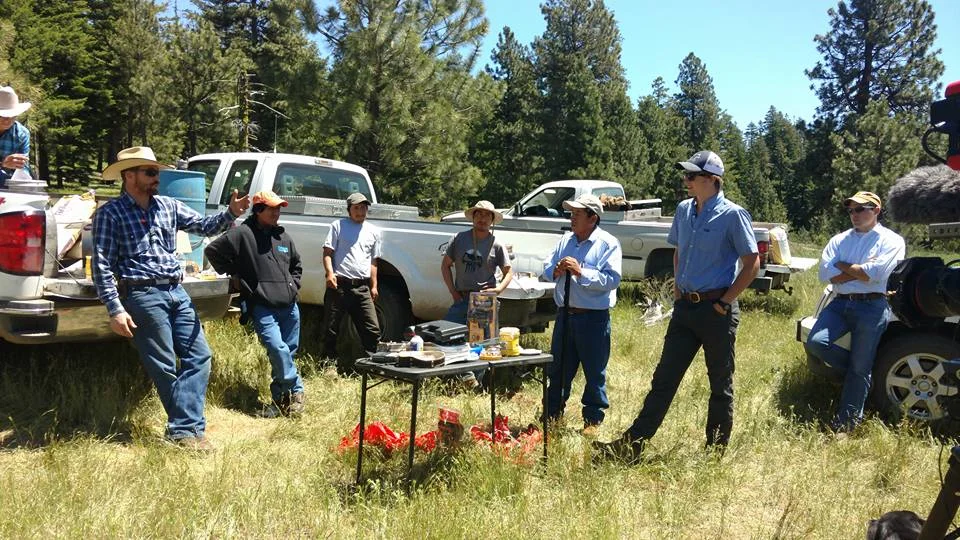
Reid and Claudio demonstrating the use of nonlethal tools. Photo: Shane Stevenson
The Wildlife Society's Colorado Chapter's Annual Meeting
Gray Wolf Conservation and Management Symposium in Fort Collins, CO
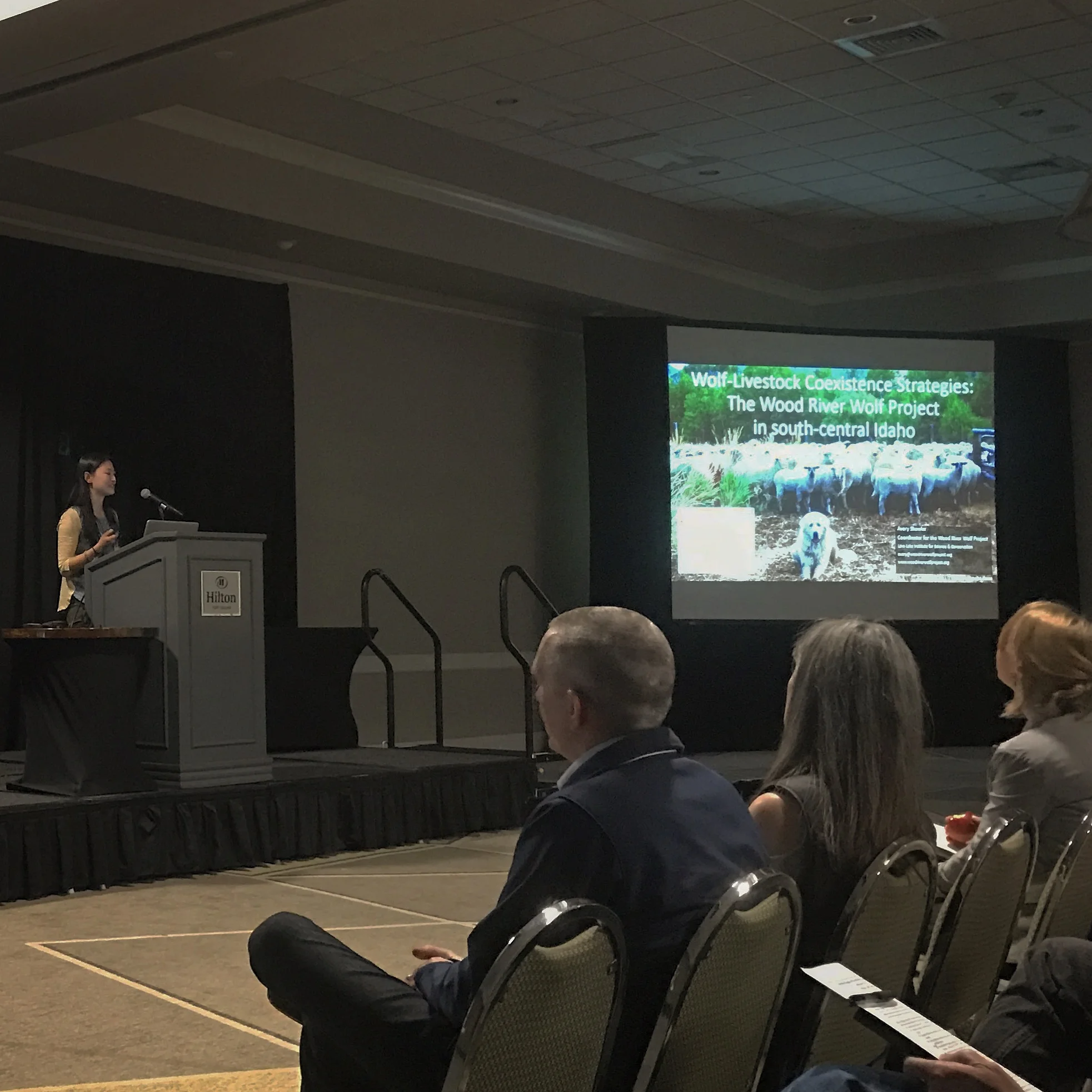
February 2017
Avery Shawler, the Project Coordinator, spoke about the success of the Project and how coexistence is possible. She spoke among highly-respected wolf biologists such as Dave Mech, Mike Phillips, Doug Smith, Carter Niemeyer (WRWP Collaborator), and others.

A screenshot from the Oversight Hearing video

A screenshot from the video of the congressional hearing
April 2016
Brian Bean spoke at a congressional hearing on the Endangered Species Act applauding its success with the comeback of grizzly bears and wolves. You can view the video of the hearing here and Brian starts speaking around the 51:00 minute mark.
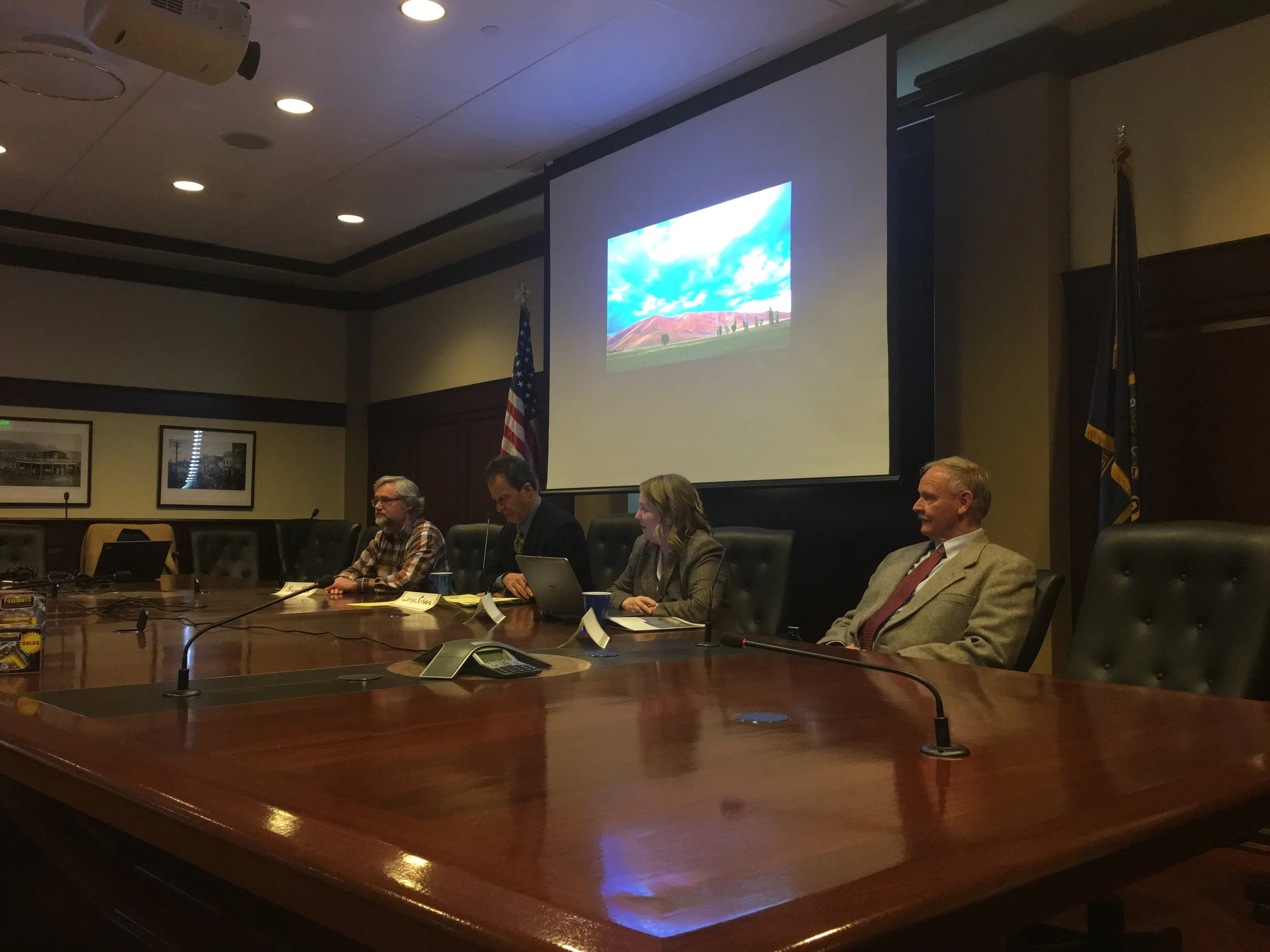
Left to right: Brian Bean, Larry Schoen, Suzanne Stone, and Carter Niemeyer.
Photo: Avery Shawler
March 2016
Brian Bean spoke in front of Idaho legislators about the Project. Other Project collaborators were present and answered questions from legislators. Listen to the presentation here.
Nonlethal Tools: Ranching with Predators Workshop in McArthur, California
February 2016
Brian Bean gave a presentation remotely to ranchers in an event organized by USDA APHIS Wildlife Services. Here's a blog post from Defenders of Wildlife about the event: http://www.defendersblog.org/2016/02/learning-to-live-with-california-wolves/
Wolf Advisory Group Meeting in Spokane, Washington
December 2015
Brian Bean spoke about nonlethal tools specifically in regard to preventing sheep depredation. He presented alongside Hilary Zaranek, a range rider from a cattle operation in the Centennial Valley in Montana.
Wood River Wolf Project Training Workshop
June 2014
The Project hosted a two-day training workshop with a classroom and field component to train people how to use nonlethal tools and techniques. People from all over the country and all over the world participated.

Participants of the workshop out in the field.
Photo: Suzanne Stone

Classroom component of the workshop.
Photo: Suzanne Stone